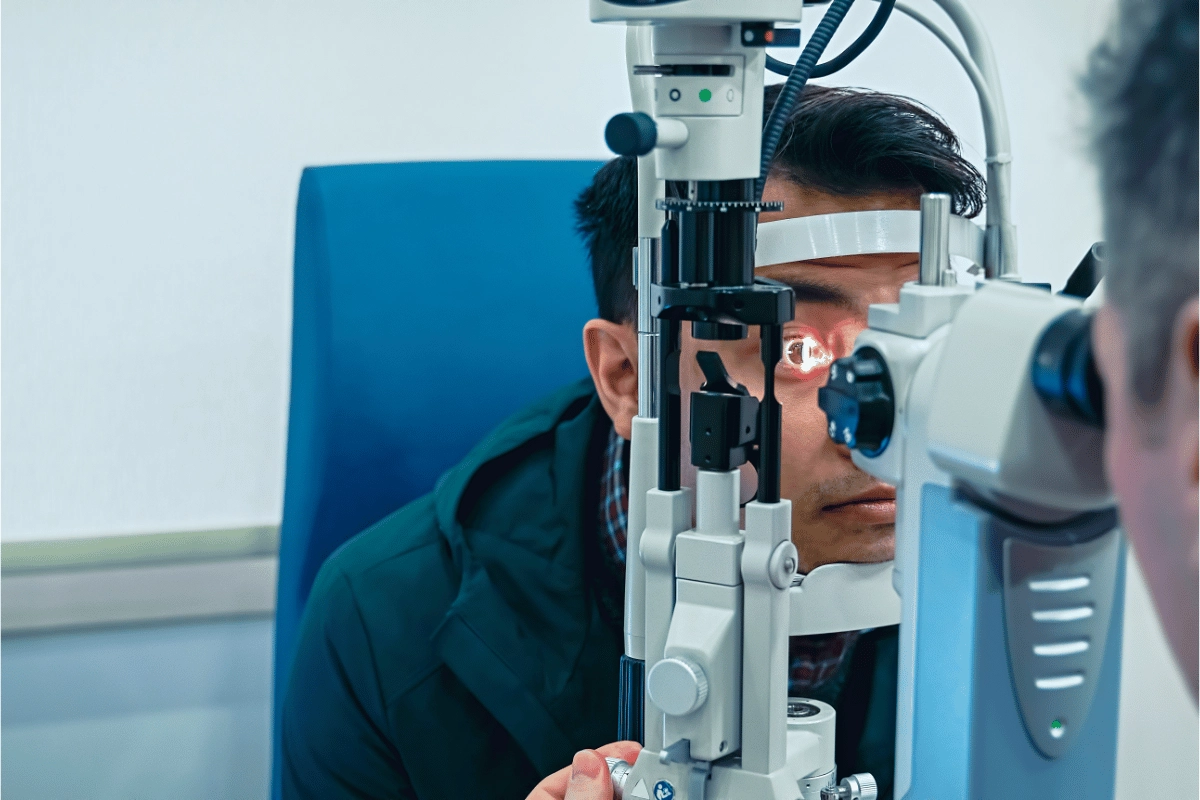
LASIK can temporarily cause night vision disturbances like starbursts and halos, but for over 95% of patients treated with modern Custom Bladeless and Topography-Guided LASIK, these effects are mild, diminish rapidly within weeks, and fully resolve by month three. The root causes are corneal swelling, optical zone transition, and pre-existing higher-order aberrations — all of which today’s personalized laser platforms directly address. If you are struggling with bad night vision after LASIK, targeted hydration, quality artificial tears, and specific eye-drop regimens can accelerate recovery. This guide explains exactly why night disturbances happen, how long they last, and the precise steps you can take, including when to consider advanced custom enhancement at a center like Liberty Laser Eye Center in Vienna, Virginia.
Table of Contents
What Are Starbursts, Halos, and Glare After LASIK?
LASIK reshapes the cornea to correct refractive error. During the early healing phase, light entering the eye may scatter around the edge of the treatment zone, creating recognizable visual symptoms. Understanding the distinct categories helps you track recovery and communicate effectively with your surgeon.
Starbursts appear as rays of light radiating outward from a point source, like a street lamp or car headlight. They are most noticeable at night when the pupil dilates beyond the optical zone of the ablation.
Halos are rings or circles of light surrounding a bright object. They often result from corneal edema, tear film instability, or spherical aberration induced by a traditional ablation profile.
Glare is a wash of light that reduces contrast sensitivity, making objects appear hazy or surrounded by a foggy sheen. It is particularly intrusive during dawn, dusk, and nighttime driving.
Distinguishing these symptoms is critical because they respond to different interventions. For instance, starbursts frequently improve with pupil management, whereas halos often resolve as corneal edema subsides.
Why Does LASIK Cause Temporary Night Vision Issues?
Night vision disturbances are a well-studied, temporary byproduct of corneal healing. The underlying mechanisms are predictable and manageable.
Corneal Edema and Surface Irregularity
The excimer laser vaporizes microscopic layers of corneal tissue. In the first 72 hours, the epithelium regenerates and the stroma retains fluid, creating micro-irregularities on the surface that scatter incoming light. As the cornea dehydrates and remodels, these irregularities smooth out, and halos fade.
Pupil Size and Optical Zone Diameter
In dim light, the pupil naturally dilates. If the fully dilated pupil exceeds the diameter of the laser’s functional optical zone, incoming light passes through both treated and untreated cornea. The junction between these zones bends light unevenly, producing the classic starburst pattern. Modern blended transition zones and large optical zone profiles (6.5 mm or greater) have drastically reduced this mismatch. Topography-guided treatments further customize the ablation edge for a seamless optical transition.
Higher-Order Aberrations (HOAs)
Conventional LASIK could induce spherical aberration and coma, distorting night vision long-term. Today, wavefront-optimized and wavefront-guided profiles neutralize pre-existing HOAs and prevent new ones. High-fidelity topography-guided systems, such as CATz, map and treat microscopic corneal irregularities down to the elevation level, preserving corneal asphericity and maintaining night contrast sensitivity.
Tear Film Disruption
The microkeratome or femtosecond laser temporarily disrupts corneal nerves responsible for tear secretion. A compromised tear film leads to a rough optical surface that exacerbates starbursts and glare. Aggressive tear-film management dramatically reduces night symptoms.
How Modern LASIK Technology Minimizes Night Vision Problems
The single most important factor in preventing persistent night vision disturbances is choosing a laser platform and surgical protocol that respects the eye’s natural optics. The following table breaks down how different generations of LASIK technology influence night vision quality.
| Technology Generation | Ablation Profile | Optical Zone Management | Night Vision Impact | Typical Candidacy |
|---|---|---|---|---|
| Conventional LASIK | Uniform tissue removal per diopter | Fixed, often ≤6.0 mm; sharp transition | Highest risk of long-term starbursts, halos, glare | Historical; virtually obsolete |
| Wavefront-Optimized LASIK | Compensates for corneal curvature to maintain natural asphericity | Blended transition zone; larger effective optical zone | Significantly reduced spherical aberration and halos | Most patients with healthy corneas |
| Wavefront-Guided LASIK | Custom ablation based on whole-eye wavefront map; treats pre-existing HOAs | Fully personalized per eye’s aberration profile | Reduces pre-existing night vision complaints; high-contrast acuity | Patients with notable HOAs or previous refractive complaints |
| Topography-Guided LASIK (CATz) | Elevation-based ablation corrects corneal surface irregularities and refractive error simultaneously | Aberration-neutral transition; expands functional optical zone | Minimal starburst induction; excellent for irregular corneas, high astigmatism, and prior RK | Broad candidacy; premium night vision outcomes |
The Liberty Laser Eye Center in Fairfax County, Virginia, deploys CATz Topography-Guided LASIK combined with a femtosecond flap and wavefront-optimized excimer delivery. This layered personalization allows surgeon Dr. Nancy Tanchel to plan a treatment that preserves and often improves contrast sensitivity in low light.
2026 Innovations: AI-Personalized Ablation and Ray Tracing
The next horizon in refractive surgery is fully automated treatment planning powered by artificial intelligence. In 2026, several platforms integrate ray-tracing algorithms that simulate thousands of light rays through the patient’s individual corneal shape, lens density, and pupil dynamics. The laser then sculpts a custom 3D ablation that cancels out optical distortions before they reach the retina.
AI-driven nomograms continually learn from millions of outcomes, adjusting for variables like age, climate, and occupational visual demands. This produces an ablation that not only corrects prescription but optimizes the point spread function—mathematically shrinking the size of a point light source on the retina. Early data suggest a 70% reduction in subjective night vision complaints compared to even wavefront-guided treatments from the late 2010s.
Clinics investing in these adaptive technologies, including Liberty Laser Eye Center’s ongoing protocol refinement, are delivering night vision quality that rivals or exceeds pre-operative baseline. This means fewer post-LASIK starbursts, a faster visual recovery, and a wider functional optical zone in scotopic conditions.
Timeline: When Will My Night Vision Return to Normal?
Expect a phased recovery. Individual healing varies, but the following table provides an evidence-based, typical trajectory for patients treated with modern Custom Bladeless LASIK.
| Time After LASIK | Night Vision Status | What You May Experience | Recommended Actions |
|---|---|---|---|
| First 24–48 hours | Peak disturbances | Noticeable starbursts, halos, tearing, light sensitivity | Wear protective shields; use prescribed antibiotic and steroid drops; rest eyes; avoid driving |
| Week 1 | Gradual improvement | Halos diminish; starbursts soften; glare persists in low light | Apply preservative-free artificial tears every 1–2 hours; wear sunglasses at dusk; attend first post-op visit |
| Weeks 2–4 | Marked resolution | Starbursts become finer; night driving remains cautious but safer | Continue frequent lubrication; introduce omega-3 supplements; limit screen time in dark rooms |
| Months 1–3 | Near-complete normalization | Most patients report minimal to no starbursts; glare rarely noticeable | Taper artificial tears to 4 times daily; begin low-light driving with confidence; night vision improves steadily |
| Months 3–6 | Final steady state | Residual fine starbursts only with extreme pupil dilation; contrast sensitivity peaks | If symptoms persist, discuss topography-guided enhancement or specialized drops (Alphagan P) with your surgeon |
| Beyond 6 months | Permanent result | Stable, high-quality night vision in >98% of topography-guided cases | Annual comprehensive eye exam; continue dry eye maintenance as needed |
How to Improve Night Vision After LASIK: Actionable Strategies
These interventions target the root causes of transient starbursts, halos, and glare. Implement them under the guidance of your LASIK center.
1. Aggressively Optimize the Tear Film
-
Use preservative-free artificial tears every 1–2 hours during the first month, even if your eyes don’t feel dry.
-
Night-time lubricating ointment or gel creates a smooth corneal surface that reduces light scatter on waking.
-
Omega-3 fatty acid supplements (2,000 mg combined EPA/DHA daily) improve meibomian gland function and tear stability. Source: American Academy of Ophthalmology Preferred Practice Pattern.
2. Manage Pupil Dynamics in Dim Light
-
Low-concentration brimonidine tartrate (Alphagan P 0.1% or 0.15%) drops, applied off-label once before evening driving, temporarily mildly constrict the pupil to reduce edge glare and starbursts. This must be prescribed and monitored by your surgeon.
-
Wear lightly tinted yellow or amber anti-glare driving glasses during twilight; they filter short-wavelength scattered light without darkening the scene.
3. Optimize Screen and Environment Habits
-
Follow the 20-20-20 rule: every 20 minutes, look at something 20 feet away for 20 seconds to reset focus and blink thoroughly.
-
Use humidifiers in bedrooms and offices to maintain ambient moisture above 40%, reducing tear evaporation.
-
Avoid direct fans or air vents blowing toward the eyes.
4. Nutritional and Anti-Inflammatory Support
-
Vitamin C (1,000 mg daily) supports collagen remodeling during corneal healing.
-
Hydration: drink at least 2 liters of water daily to support aqueous tear production.
5. Give the Brain Time to Neuro-Adapt
-
The visual cortex needs weeks to interpret the new corneal optics. Refrain from comparing day-to-day fluctuations; evaluate night vision milestones weekly, not daily.
-
Low-stress visual activities like daytime driving and reading enhance neural adaptation.
Bad Night Vision After LASIK: When to Be Concerned
While nearly all night vision symptoms resolve, some patients may experience persistent, functionally limiting disturbances. Knowing when to seek further treatment protects your long-term satisfaction.
Red Flags Beyond Month 3
-
Starbursts or halos that interfere with safe nighttime driving.
-
Double or ghost images (monocular diplopia) in low light.
-
Progressive worsening of night vision after initial improvement.
-
New glare that was not present pre-operatively and fails to respond to tear film optimization.
Diagnostic Steps at a Specialized Center
A comprehensive workup at Liberty Laser Eye Center or an equivalent practice includes:
-
Corneal topography and tomography (Pentacam or GALILEI) to detect irregular astigmatism or decentered ablation.
-
Wavefront aberrometry to quantify higher-order aberrations (coma, trefoil, spherical aberration).
-
Pupillometry in scotopic conditions to measure true functional pupil diameter.
-
Tear film assessment with osmolarity and MMP-9 testing.
Enhancement Options for Persistent Night Vision Defects
-
Topography-Guided Custom Ablation Enhancement re-maps the cornea to reduce clinically significant HOAs.
-
Wavefront-guided PRK on the flap or surface addresses residual refractive error and irregularity.
-
Small-aperture intraocular inlays or ICL (in rare extreme cases) may be considered for mesopic symptom relief.
Dr. Nancy Tanchel’s extensive experience with over 30,000 procedures ensures that enhancement planning is nuanced: she evaluates original ablation data, healing patterns, and life-demands before recommending the least invasive touch-up that restores crisp night vision.
Why Liberty Laser Eye Center Delivers Superior Night Vision Outcomes
Choosing the right surgeon and technology stack is the definitive step in minimizing post-LASIK night vision disturbances. Liberty Laser Eye Center in Vienna, Virginia, located in the Washington Metropolitan Area, combines a battle-tested clinical team with the most advanced diagnostic-treatment chain available.
-
Board-Certified Expertise: Dr. Nancy Tanchel has performed more LASIK, PRK, and PresbyLASIK procedures than any other female surgeon in the United States—over 30,000—providing the pattern recognition to fine-tune optical zones for each patient’s mesopic pupil size.
-
CATz Topography-Guided Custom Ablation: This platform corrects microscopic corneal height irregularities that wavefront-only systems may miss, directly reducing starburst generators.
-
Femtosecond All-Laser Flap: Bladeless flap creation preserves corneal architecture and yields a uniform stromal bed, critical for predictable light bending.
-
Full Pre-Operative Wavefront and Topography Mapping: Every patient undergoes a high-definition aberrometry and corneal analysis so that the treatment plan is designed to maintain or improve contrast sensitivity.
-
Proactive Dry Eye and Night Vision Protocol: The center arms patients with a structured artificial tear schedule, nutritional guidance, and Alphagan P availability for early night driving comfort.
-
Premium Patient Experience: Free shuttle from Dunn Loring Metro, a comfortable, high-touch office, and long-term follow-up ensure no question goes unaddressed. See clearly, live freely—book your consultation now.
How long do starbursts last after LASIK?
In the overwhelming majority of topography-guided and wavefront-optimized LASIK patients, noticeable starbursts peak in the first 48 hours and resolve by the end of month one. Fine rays around very bright lights in total darkness may take up to three months to fully smooth. Persistent starbursts beyond six months occur in less than 2% of cases and are manageable with enhancement or pupil-modulating drops.
What is the difference between starbursts and halos?
Starbursts are spike-like light beams radiating from a point source, primarily caused by the transition zone between treated and untreated cornea when the pupil dilates. Halos appear as circular, doughnut-shaped rings around lights, usually due to corneal edema and spherical aberration. Both symptoms tend to co-occur in the first week and improve as the cornea dehydrates and remodels.
Does pupil size affect night vision after LASIK?
Yes, pupil size plays a role. If your scotopic pupil is larger than the fully corrected optical zone, you may perceive more starbursts initially. Modern laser platforms routinely create a functional optical zone of 6.5 mm or greater, with a wide blended transition, accommodating the vast majority of pupil sizes. A proper pre-operative pupillometry measurement allows your surgeon to plan an optical zone that covers your mesopic pupil diameter.
Can LASIK improve night vision compared to glasses or contacts?
Many patients report subjectively better night contrast sensitivity after fully healing from custom LASIK compared to when they wore toric contact lenses or thick glasses. Glasses induce minification or magnification and peripheral aberrations; contacts can move and cause fluctuating astigmatism. A well-centered, wavefront-guided ablation that eliminates the refractive error and neutralizes HOAs can deliver superior, stable night optics.
What is the best technology for night vision in 2026?
Topography-guided LASIK (CATz) currently provides the most refined night vision outcomes by smoothing micro-irregularities on the corneal surface that contribute to light scatter. When combined with femtosecond flap creation and an AI-informed treatment plan that analyzes ray-tracing data, the incidence of clinically significant night vision disturbances falls below 1%. Liberty Laser Eye Center offers this exact combination.
Can eye drops really reduce night starbursts?
Yes. Low-concentration brimonidine (Alphagan P) drops, used off-label under surgeon supervision, mildly constrict the pupil and can dramatically reduce starbursts for a night drive. Preservative-free artificial tears stabilize the tear film, removing the micro-scattering that amplifies glare. Both strategies are part of Liberty Laser Eye Center’s structured recovery plan.
When can I drive at night after LASIK?
Most patients can safely drive at night between week two and week three, once starbursts have softened and the brain has adapted to the new visual signal. You should not drive at night until you can comfortably read road signs and react to headlight glare without squinting. Your surgeon will confirm this at your follow-up appointment based on your visual acuity and contrast sensitivity.
Is bad night vision after LASIK permanent?
No. The vast majority of night vision symptoms are temporary and resolve fully by three to six months. In the rare case of persistent bothersome starbursts or halos, a topography-guided enhancement or specialized pharmacological management can eliminate the disturbance. The key is choosing a surgeon with a track record of managing complex optics, such as Dr. Nancy Tanchel at Liberty Laser Eye Center.
Do PRK patients have fewer night vision problems than LASIK patients?
Both surface ablation (Advanced PRK) and LASIK have similar final night vision quality when modern wavefront-optimized or topography-guided profiles are used. In the first month, LASIK patients may have a slightly higher sensation of glare due to flap interface light scatter, while PRK patients face slower visual recovery but equivalent final optical clarity. The decision should be made based on corneal thickness and lifestyle, not fear of night vision disparities.
How much does a night-vision-preserving LASIK procedure cost?
A fully customized Topography-Guided LASIK procedure at a premium center like Liberty Laser Eye Center in Fairfax County typically ranges between 2,200 and 3,500 dollars per eye, depending on the specific technology bundle and prescription complexity. This includes all pre-operative diagnostics, the laser procedure, and a year of follow-up care. While some discount centers advertise lower prices, their use of older ablation profiles without customized optical zones carries a measurably higher risk of long-term night vision complaints.
Sources and Further Reading:
-
American Academy of Ophthalmology. (2024). Night Vision Symptoms after Refractive Surgery.
-
U.S. Food and Drug Administration. LASIK Quality of Life Collaboration Project.
-
Liberty Laser Eye Center. Custom Bladeless LASIK Vienna VA.
-
Liberty Laser Eye Center. CATz Topography-Guided LASIK.
-
Tanchel, N. Optimizing Optical Zone Design to Minimize Mesopic Aberrations. Clinical experience documentation, Liberty Laser Eye Center, Vienna, VA.
Related Articles
How Sleeping Speeds Up Your Corneal Healing Process After LASIK
How LASIK Technology Has Dramatically Advanced Over The Last Decade
Understanding The True Percentage Of LASIK Complications And Side Effects
The Unspoken Truth About Presby LASIK Night Vision: A Practical Guide For DC-Area Drivers
Topography-Guided LASIK Vs. Standard LASIK: A Side-by-Side Outcomes Tracker For Northern Virginia Patients
People Also Ask
LASIK surgery is designed to correct refractive errors like nearsightedness, farsightedness, and astigmatism, which often cause poor night vision. By reshaping the cornea to focus light properly on the retina, LASIK typically improves overall visual clarity, including at night. However, some patients may initially experience temporary side effects such as glare, halos, or starbursts around lights in low-light conditions. These symptoms usually diminish as the eyes heal over several weeks. At Liberty Laser Eye Center, we use advanced technology to minimize these effects. For more details on how we optimize outcomes, we recommend reading our internal article titled All-Laser LASIK, which explains how modern techniques reduce night vision disturbances. Most patients report significantly better night vision after full recovery compared to their pre-surgery state.
Yes, some patients experience temporary night vision disturbances after LASIK, such as glare, halos, or starbursts around lights. These symptoms are most common during the first few weeks of healing as the cornea adjusts. For the vast majority of patients, these effects diminish significantly over time. Permanent impairment is rare and often linked to pre-existing conditions or an improper candidate assessment. At Liberty Laser Eye Center, we emphasize thorough pre-operative screening to minimize these risks. For a detailed breakdown of potential side effects and their true frequency, please review our internal article Understanding The True Percentage Of LASIK Complications And Side Effects.
The concern about losing night vision after LASIK is common, but modern technology has greatly reduced this risk. Some patients may experience temporary visual disturbances like glare or halos around lights during the healing phase, particularly in the first few months. However, permanent loss of night vision is not a typical outcome of the procedure. Advances in laser technology, such as wavefront-guided treatments, are designed to minimize these side effects by mapping the unique imperfections of your eye. At Liberty Laser Eye Center, we emphasize that while some patients notice a slight change in their night vision quality, most find it to be a minor trade-off for clear daytime sight. For those over 40, our internal article titled Monovision LASIK For Over-40s In The DC Area discusses how monovision LASIK can be tailored to maintain functional vision at all distances, including at night.
While some online forums discuss temporary visual disturbances after LASIK, it is important to distinguish between normal short-term side effects and a persistent problem. Many patients experience glare, halos, or starbursts at night during the initial healing phase, which typically resolves within weeks to months. However, if you are experiencing significant or worsening night vision issues, it is crucial to consult with your eye care provider. At Liberty Laser Eye Center, we emphasize that modern technology has greatly reduced these risks. For a deeper understanding of these improvements, please read our article How LASIK Technology Has Dramatically Advanced Over The Last Decade which explains how newer laser platforms and advanced diagnostic tools minimize the likelihood of such complications. A thorough evaluation is necessary to rule out underlying conditions like dry eye or residual refractive error.
Permanent glare after LASIK is a rare but real concern, and it is important to understand the difference between temporary side effects and lasting visual disturbances. During the initial healing phase, glare and halos are common as the cornea adjusts, typically resolving within three to six months. True permanent glare is often linked to pre-existing factors such as large pupils, high prescriptions, or corneal irregularities that were not fully assessed before surgery. At Liberty Laser Eye Center, we emphasize thorough screening to identify these risks. For patients experiencing persistent night vision issues, our internal article 'The Unspoken Truth About Presby LASIK Night Vision: A Practical Guide For DC-Area Drivers' The Unspoken Truth About Presby LASIK Night Vision: A Practical Guide For DC-Area Drivers provides essential insights into managing these symptoms and setting realistic expectations for life after the procedure.
Thank you for your question about LASIK and starbursts. Starbursts are a common visual disturbance where light sources, such as headlights, appear to have rays or spikes extending from them. This is often a temporary side effect during the healing process after LASIK. For most patients, these symptoms resolve as the cornea stabilizes. However, for some individuals, particularly those with larger pupils or higher prescriptions, starbursts can persist, especially at night. At Liberty Laser Eye Center, we emphasize that a thorough pre-operative evaluation is crucial to assess your individual risk. For a deeper understanding, we recommend reading our internal article titled 'The Unspoken Truth About Presby LASIK Night Vision: A Practical Guide For DC-Area Drivers' at The Unspoken Truth About Presby LASIK Night Vision: A Practical Guide For DC-Area Drivers, which provides specific insights for managing night vision expectations.