


I had a great experience at Liberty Laser Eye Center. Dr. Nancy Tanchel and her entire team were extremely professional, kind, and made me feel comfortable throughout the whole process. They explained everything clearly and answered all of my questions, which really helped me feel confident before the procedure.
The surgery went smoothly and the staff was very supportive from start to finish. I’m very grateful to Dr. Tanchel and her team for their excellent care and professionalism.
Thank you all for helping me improve my vision. I truly appreciate the great work you do.

My vision wasn't terrible, but I was just sick of dealing with the hassle of contacts for sports until I came here. Great and professional business

I had a really good experience at Liberty Laser Eye Center. The staff was friendly and made me feel comfortable the whole time. The procedure was quick, and my vision is so much better now.

Informative staff offering careful evaluations and supportive patient care throughout the process.

Having LASIK surgery was the best thing I have ever done. Waking up every morning with the ability to see 20/20 without having to reach for my glasses or contacts is the ultimate freedom. The surgery was painless and the staff was incredible. I highly recommend it so don't wait!

Brought My grandmother for her eye exam. Jeeimy helped us and explained in detail such amazing team.

I’d been thinking about LASIK for years but kept putting it off out of sheer nervousness. The staff at Liberty are some of the kindest and most patient people I’ve ever met. It’s been a few months and I’m still not used to the freedom of just rolling out of bed and seeing.

I consider this the best investment I've ever made in myself, no question about it. The freedom of just rolling out of bed and being able to see is something I'll never take for granted.
Corneal crosslinking is a minimally invasive procedure that typically involves minimal discomfort. During the procedure, the eye is numbed with anesthetic drops, so patients do not feel pain. However, some patients report a feeling of pressure or mild irritation. The most common period of discomfort occurs in the first 24 to 72 hours after the treatment, as the corneal epithelium heals. This can include sensations of grittiness, light sensitivity, tearing, and moderate pain, which is usually well-managed with prescribed lubricating drops and oral pain medication. The procedure is performed to strengthen the cornea and halt the progression of conditions like keratoconus, and any post-operative discomfort is temporary and a normal part of the healing process.
Corneal cross-linking is not considered a major surgery. It is a minimally invasive, outpatient procedure typically performed in a clinic or surgical center. The goal is to strengthen the cornea to halt the progression of conditions like keratoconus. The process involves applying riboflavin (vitamin B2) eye drops to the cornea and then activating them with controlled ultraviolet light. While it is a significant medical treatment, it does not involve major incisions or general anesthesia; often only topical anesthetic drops are used. Recovery is relatively quick, though patients may experience some discomfort and blurry vision for a few days. It is a highly specialized procedure but falls well outside the category of major surgical interventions.
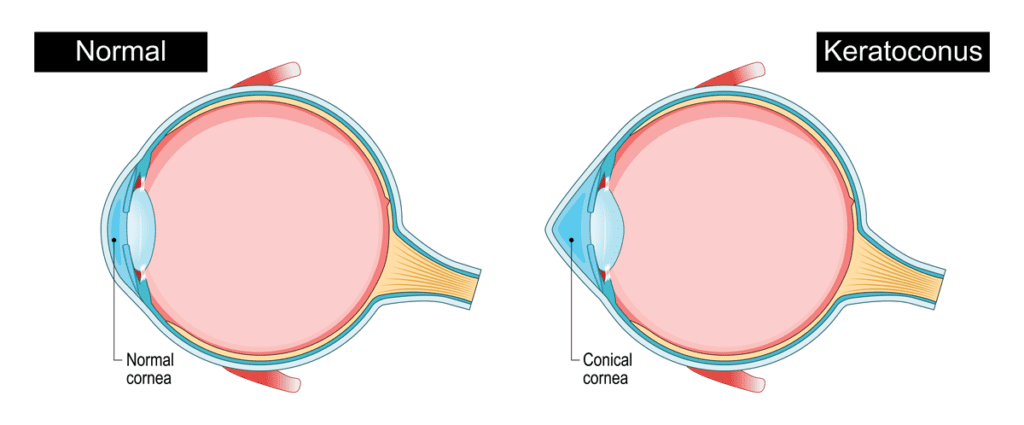
Cross-linking and LASIK are fundamentally different procedures for different conditions. LASIK is a refractive surgery designed to correct nearsightedness, farsightedness, and astigmatism by reshaping the cornea. Corneal cross-linking is a treatment to halt the progression of keratoconus, a disease where the cornea thins and bulges outward. It is not a vision-correcting procedure on its own, though it can be combined with other treatments. Therefore, one is not "better" than the other; they serve distinct purposes. For individuals with thin or irregular corneas who are not LASIK candidates, exploring alternatives is crucial. Our detailed resource, Thin Corneas? Alternative Vision Correction Options, discusses these options thoroughly.
Crosslinking, while a highly effective procedure to halt the progression of keratoconus and other corneal ectasias, does have potential disadvantages. The most common is temporary discomfort, including pain, light sensitivity, and blurred vision during the initial healing period, which can last several days. There is a small risk of infection or corneal haze, though this is minimized with proper surgical technique and post-operative care. The procedure is not typically intended to improve vision but to stabilize the cornea; any vision improvement is a secondary benefit and not guaranteed. In rare cases, over-treatment could lead to corneal flattening. It is crucial to have a thorough evaluation with a corneal specialist to discuss these risks versus the significant benefit of preventing further vision deterioration.
The cost of corneal cross-linking (CXL) can vary significantly based on geographic location, the specific clinic, the technology used, and whether the procedure is performed epi-on or epi-off. In the United States, the average price range is typically between $2,500 and $4,000 per eye. This is generally an out-of-pocket expense, as most insurance plans still consider it investigational for keratoconus, though coverage is becoming more common. It is crucial to obtain a detailed consultation that includes all associated fees for diagnostics, follow-up care, and any potential enhancements. Patients should verify what the quoted price includes and explore any available financing options or insurance pre-authorization.
Corneal cross-linking (CXL) is a highly effective procedure to halt the progression of keratoconus, but it does carry potential side effects. The most common are temporary and include discomfort, light sensitivity, and blurred vision in the days following treatment. There is a risk of infection or inflammation, though this is minimized with proper post-operative care using prescribed antibiotic and steroid eye drops. In rare cases, patients may experience corneal haze, which typically resolves over time, or a delay in the healing of the corneal surface. Permanent vision loss is extremely rare. It is crucial to have a thorough pre-operative evaluation with a qualified surgeon to discuss your individual risk profile and the extensive safety protocols in place to manage these potential side effects.


130 reviews

