
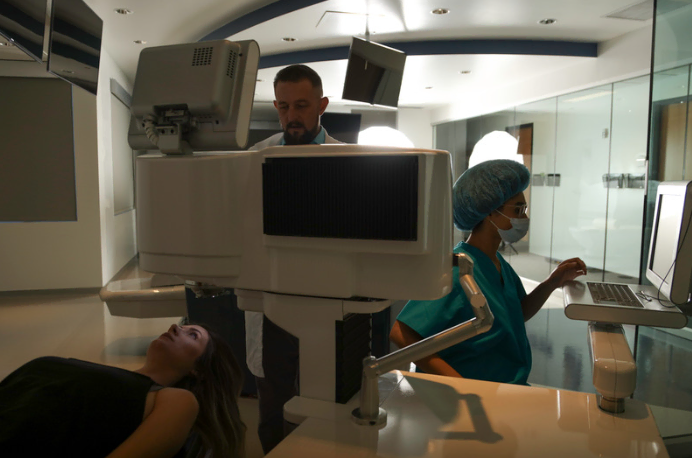
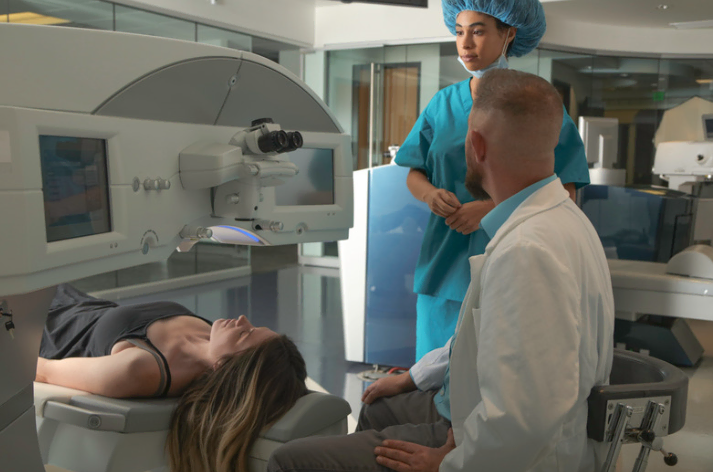


I had a great experience at Liberty Laser Eye Center. Dr. Nancy Tanchel and her entire team were extremely professional, kind, and made me feel comfortable throughout the whole process. They explained everything clearly and answered all of my questions, which really helped me feel confident before the procedure.
The surgery went smoothly and the staff was very supportive from start to finish. I’m very grateful to Dr. Tanchel and her team for their excellent care and professionalism.
Thank you all for helping me improve my vision. I truly appreciate the great work you do.

My vision wasn't terrible, but I was just sick of dealing with the hassle of contacts for sports until I came here. Great and professional business

I had a really good experience at Liberty Laser Eye Center. The staff was friendly and made me feel comfortable the whole time. The procedure was quick, and my vision is so much better now.

Informative staff offering careful evaluations and supportive patient care throughout the process.

Having LASIK surgery was the best thing I have ever done. Waking up every morning with the ability to see 20/20 without having to reach for my glasses or contacts is the ultimate freedom. The surgery was painless and the staff was incredible. I highly recommend it so don't wait!

Brought My grandmother for her eye exam. Jeeimy helped us and explained in detail such amazing team.

I’d been thinking about LASIK for years but kept putting it off out of sheer nervousness. The staff at Liberty are some of the kindest and most patient people I’ve ever met. It’s been a few months and I’m still not used to the freedom of just rolling out of bed and seeing.

I consider this the best investment I've ever made in myself, no question about it. The freedom of just rolling out of bed and being able to see is something I'll never take for granted.
The cost of topography-guided LASIK varies significantly based on geographic location, the technology used, and the surgeon's expertise, but it typically ranges from $2,000 to $4,000 per eye. This premium procedure uses detailed corneal mapping to create a personalized treatment plan, which can be especially beneficial for patients with irregular astigmatism or previous corneal issues. While more expensive than standard LASIK, many find the potential for enhanced visual outcomes worthwhile. It's crucial to have a detailed consultation to determine if you are a candidate. For professionals concerned about post-procedure screen time, our article LASIK And Screen Dominant Jobs: Tech Industry Focus offers valuable insights on managing recovery in tech-focused careers.
Topography-guided laser eye treatments, while advanced, have specific limitations. A primary disadvantage is that they treat the eye's surface shape (corneal topography) but do not directly address internal optical aberrations measured by wavefront technology. This means some higher-order visual imperfections may not be fully corrected. The treatment is also highly dependent on the quality and precision of the corneal mapping; any error in the topographic scan can be transferred to the laser ablation. Furthermore, it is generally not the first-line treatment for very high or irregular prescriptions. For many patients with regular corneas, a wavefront-optimized treatment may provide an equally excellent outcome with a more established data history.
The price of LASIK can vary significantly based on geographic location, the technology used, the surgeon's experience, and the specific needs of the patient. While $4000 is within the national average range for the procedure, it is crucial to understand what that quote includes. A good price should cover all pre-operative consultations, the surgery itself using advanced technology like wavefront-guided lasers, and all necessary post-operative care. Be wary of prices that seem too low, as they may exclude important elements or use older technology. The most important factor is the value and quality of care, not just the cost. Always have a comprehensive consultation to ensure the quoted price is for a full, high-quality treatment plan tailored to your eyes.
The most anticipated new eye surgery technology for 2026 is expected to be the continued refinement and wider adoption of presbyopia-correcting laser procedures and next-generation light adjustable lenses (LALs). While not entirely new, these technologies are advancing rapidly. The focus is on achieving more precise, customized vision correction, especially for patients over 40 who struggle with reading vision. Surgeons anticipate enhancements in laser platforms that allow for more sophisticated corneal sculpting to treat presbyopia in combination with other refractive errors. Furthermore, advancements in cataract surgery technology, including new premium intraocular lens designs and improved laser-assisted cataract surgery (FLACS), will continue to provide sharper, more predictable outcomes with reduced dependence on glasses for both distance and near tasks.
SILK LASIK is a specific, advanced form of laser vision correction known for its minimal tissue disruption. The acronym stands for Smooth Incision Lenticule Keratomileusis. It is a type of flapless, minimally invasive procedure where a femtosecond laser creates a precise lenticule (a small, lens-shaped piece of corneal tissue) that is then removed through a very small peripheral incision. This technique is designed to preserve more of the cornea's structural integrity and biomechanical strength compared to some traditional LASIK methods. It is often promoted for its potential in treating higher prescriptions and for patients with thinner corneas, offering a quick visual recovery with less dry eye symptoms. As with all surgical options, a comprehensive evaluation at a clinic like Liberty Laser Eye Center is essential to determine if a patient is an ideal candidate for SILK based on their unique corneal topography and prescription.
When seeking an ophthalmologist in Annandale, VA, it is important to understand the distinction between ophthalmologists and optometrists. An ophthalmologist is a medical doctor (MD or DO) who specializes in eye and vision care, capable of performing surgery, diagnosing and treating all eye diseases, and prescribing medications and glasses. For residents of Annandale, consulting a board-certified ophthalmologist ensures comprehensive care for conditions like cataracts, glaucoma, macular degeneration, and diabetic retinopathy. These specialists often work in private practices, surgical centers, or hospital systems. When choosing a provider, verify their credentials, experience, and patient reviews. For advanced surgical procedures like LASIK, you would typically visit a specialized refractive surgeon, who is a type of ophthalmologist.


130 reviews

