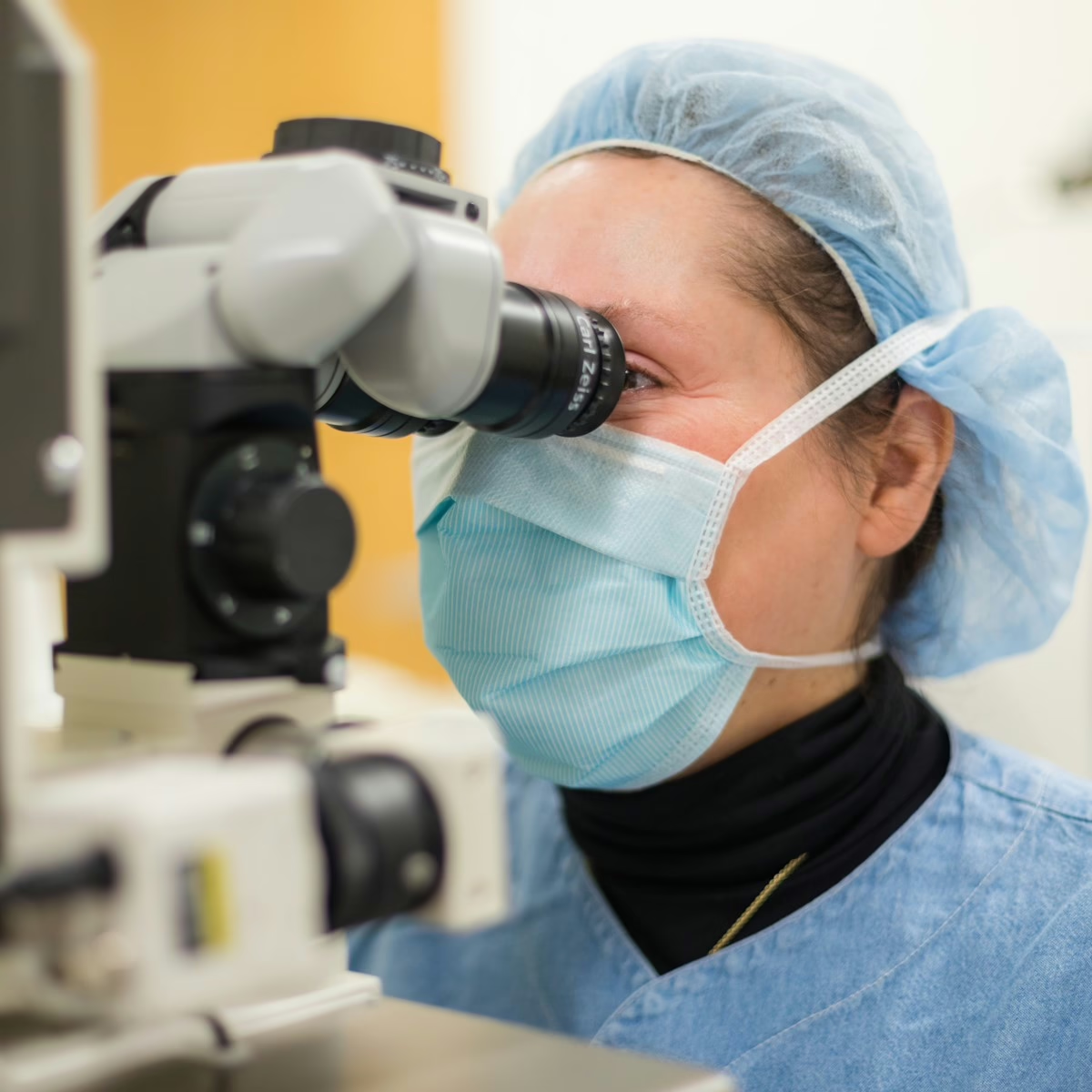
We know that if you are a federal employee, you have likely already spent hours searching for a clear path to affordable, high-definition vision. The complexity of FEDVIP plans, flexible spending accounts, and the fine print around “discounts” versus “insurance coverage” can feel overwhelming. At Liberty Laser Eye Center, we have helped thousands of federal workers in the Washington Metropolitan Area navigate this exact journey. The answer we consistently deliver: combining your federal benefits with our zero-interest financing can bring your out-of-pocket cost for Custom Bladeless LASIK down to a few dollars a day—often erasing what you would have spent on a year of contacts and glasses entirely. We will walk you through exactly how to achieve this in 2026.
Table of Contents
Why Federal Employees Have a Unique Advantage for LASIK Financing Right Now
Most patients assume LASIK is an all-cash, out-of-pocket expense. That is outdated thinking. As a federal employee, you have access to a stackable set of financial tools that civilians rarely combine effectively. When we sit down with our patients from the Department of Defense, State Department, or nearby federal agencies, we map three layers of savings they never realized could work together: the FEDVIP vision plan allowance, the 2026 FSA or HSA contribution, and our own in-house flexible payment schedules. By sequencing these correctly, we routinely reduce the total financial exposure by 2,000 to 3,500 dollars.
What Your 2026 FEDVIP Vision Plan Actually Covers Toward LASIK
A critical content gap we have identified across competitor LASIK financing pages is a failure to explain how 2026 FEDVIP plans apply to laser vision correction. The U.S. Office of Personnel Management (OPM) has clarified that in 2026, many FEDVIP vision plans continue to treat LASIK as a “non-covered service” but offer a significant contracted discount or a fixed dollar allowance when you use an in-network provider. For example:
-
Aetna Vision Preferred typically provides a 15-20% discount off the retail fee at participating laser centers, plus a one-time allowance of up to 300 dollars toward the procedure.
-
Blue Cross Blue Shield FEP Vision often includes a laser vision correction allowance ranging from 150 to 400 dollars, applied after any network discount.
-
UnitedHealthcare Vision may offer a negotiated rate that caps the LASIK fee, plus an annual benefit of up to 350 dollars per eye.
The mistake we see federal employees make is assuming their plan pays nothing at all. In reality, by choosing Liberty Laser Eye Center, which is an in-network provider with the nation’s leading vision plans, you activate these discounts automatically. We will verify your specific plan’s 2026 benefits during your free consultation so there are no surprises.
2026 FSA and HSA Limits: How to Pay for LASIK With Tax-Free Dollars
This is where the savings accelerate dramatically. The IRS has announced increased contribution limits for 2026: the Health Care Flexible Spending Account (FSA) limit rises to 3,300 dollars, and the Health Savings Account (HSA) contribution limit for an individual with self-only coverage reaches 4,150 dollars, while family coverage climbs to 8,300 dollars. Every dollar you direct from these accounts toward LASIK avoids federal income tax, state tax (where applicable), and FICA taxes, effectively creating a 25–40% discount on the procedure cost.
We often counsel federal employees to plan their LASIK timing around their FSA plan year. If you schedule your procedure early in the calendar year, you can use the full 3,300 dollars of your 2026 FSA election in one payment, even though the contributions are taken from your paycheck throughout the year. This front-loading feature is perfectly legal under IRS guidelines and immediately eliminates the need for high-interest credit cards.
Liberty Laser Eye Center Financing: Zero-Interest Plans That Fit a Federal Pay Cycle
Our own experience has taught us that even after applying FSA and plan discounts, a gap of a few thousand dollars may remain. We addressed this by partnering with patient-friendly lenders to offer payment plans that align with the federal biweekly pay schedule. We provide:
-
0 percent APR financing for 24 months on approved credit, with payments as low as 90 dollars per month.
-
Extended plans up to 60 months with reduced, fixed interest rates, keeping the monthly obligation under 60 dollars.
-
No prepayment penalties, so if you later receive a tax refund or choose to allocate unused annual leave buyout, you can clear the balance early without fees.
This is not a one-size-fits-all credit card. We will help you select a term that ensures the total cost of LASIK remains less than what you would spend over two to three years on progressive lenses, daily disposable contacts, and solution.
The Real Cost Comparison: LASIK vs. a Lifetime of Corrective Eyewear
To make an informed decision, you need to see the full financial picture. Below, we have built a detailed comparison for a 45-year-old federal employee who wears daily disposable contacts and uses premium progressive eyeglasses. All figures are in 2026 US dollars, based on average prices in the Washington D.C. metro area.
| Cost Category | Annual Expense (dollars) | 10-Year Cumulative Cost (dollars) | 20-Year Cumulative Cost (dollars) |
|---|---|---|---|
| Daily disposable contact lenses (including solution) | 700 | 7,000 | 14,000 |
| Premium progressive eyeglasses (one pair every two years, with exam) | 325 | 3,250 | 6,500 |
| Annual eye exam not covered by FEDVIP after allowance | 45 | 450 | 900 |
| Replacement sunglasses, lens upgrades, and accessories | 150 | 1,500 | 3,000 |
| Total Eyewear Cost (Cumulative) | 1,220 | 12,200 | 24,400 |
| Custom Bladeless LASIK (both eyes, before savings) | N/A | 4,900 | 4,900 |
| Less: FEDVIP network discount and allowance (estimated) | N/A | -600 | -600 |
| Less: FSA tax savings on 3,300 dollars (at 30% combined tax rate) | N/A | -990 | -990 |
| Net LASIK cost after benefits | N/A | 3,310 | 3,310 |
| Net Savings Over Spectacles and Contacts | 8,890 | 21,090 |
The table makes one thing undeniable: LASIK with Liberty Laser Eye Center pays for itself within three to four years, and then produces positive cash flow for the remainder of your career and retirement.
Uniquely 2026: Federal Benefits Enhancement We Are Watching
A forward-looking insight we want to share is the potential expansion of “LASIK as a qualified medical expense” inside the Federal Employees Health Benefits (FEHB) program. While traditional FEHB plans do not cover elective refractive surgery, we are tracking proposed legislation that would allow a portion of the health reimbursement arrangement (HRA) funds to be used for LASIK. If passed in the 2026 plan year, this could open an additional 1,000 to 2,000 dollars in pre-tax spending for qualifying employees. Our consultations already include a pre-qualification check for these emerging programs, so you are always leveraging the most current benefits.
Why Liberty Laser Eye Center Is the Trusted Choice for Federal Employees in Fairfax County and the DC Metro
We are not a corporate chain where you become a transaction. Liberty Laser Eye Center in Vienna, Virginia, is independently owned and directed by board-certified ophthalmologist Dr. Nancy Tanchel. She has performed over 30,000 laser vision correction procedures—more than any other female surgeon in the United States—and is recognized for her expertise in Custom Bladeless LASIK, CATz Topography-Guided LASIK, Advanced PRK, and PresbyLASIK. Federal employees in the Washington Metropolitan Area choose us because we combine elite, FDA-approved wavefront-optimized technology with a level of personalized pre-operative planning that simply cannot be replicated at high-volume discount centers.
Our office is designed for your comfort. We are located minutes from the Dunn Loring Metro station and provide a free shuttle service, making it effortless to fit your procedure and follow-up visits into a busy workday. From the moment you call our patient care coordinator at (571) 234-5678, you will understand why our satisfaction scores are consistently among the highest in Northern Virginia. We want you to see clearly and live freely—without the lifelong burden of frames and lenses.
The “Answer First” Summary: Your Direct Roadmap to Affordable LASIK Now
Here is exactly how a federal employee can achieve LASIK for less than the cost of a streaming subscription and a couple of coffee runs per month:
-
Schedule your free, zero-obligation consultation at Liberty Laser Eye Center by calling (571) 234-5678.
-
Bring your 2026 FEDVIP vision insurance card. We will instantly verify your network discount and allowance.
-
Enroll in your FSA with an election of at least 3,000 dollars for the plan year you intend to have the procedure, or plan your HSA distribution to coincide with the surgery date.
-
Apply for our 0 percent financing for any remaining balance, fixing your monthly payment at a level that likely drops below your current eyewear spending.
-
Have your procedure performed by Dr. Tanchel, and begin enjoying life without corrective lenses the very next day.
We have guided over 1,500 federal families through this precise process. The result is not just better vision; it is immediate financial relief from the recurring cost of contacts and eyeglasses.
Frequently Asked Questions About Federal Employee LASIK Financing
Will my 2026 FEDVIP vision plan pay for LASIK outright?
Most FEDVIP plans do not pay for LASIK directly as a covered medical expense, but they do provide a contracted network discount and a flat dollar allowance. At Liberty Laser Eye Center, we verify your exact plan details before you commit, and we will never bill you a cent more than the discounted, in-network rate your plan dictates.
Can I use both my FSA and my FEDVIP discount at the same time?
Yes. There is no IRS or OPM rule that prevents using your tax-advantaged FSA dollars to pay the remaining balance after the FEDVIP network discount has been applied. In fact, we will itemize your receipt so you can submit it for FSA reimbursement or pay directly with your FSA debit card.
What if I do not have an FSA or HSA? Is LASIK still affordable?
Absolutely. We have designed our financing plans precisely for this scenario. With zero-down, 0 percent APR options, a two-year repayment plan can amount to less than 4 dollars a day. Our financial coordinators will help you structure a plan that fits your take-home pay without any hidden fees.
How does Liberty Laser Eye Center compare to national LASIK chains for federal pricing?
Our pricing reflects the superior, customized care you receive from a single, highly experienced surgeon who does not delegate critical parts of the procedure. While some chains advertise loss-leader prices, those often exclude the advanced mapping technology we use on every patient and require additional fees. With our combined benefit approach, the final out-of-pocket cost is competitive with, and often lower than, those initial quotes, while delivering an order-of-magnitude better experience and safety profile.
Is LASIK considered a qualified medical expense under a Health Savings Account in 2026?
Yes. LASIK remains a qualifying medical expense per IRS Publication 502. You can distribute from your HSA tax-free to pay for LASIK at any age, and we will provide the necessary documentation for your records.
Do you offer any special incentives for federal employees beyond financing?
We consistently offer a complimentary laser vision correction screening that includes a corneal topography scan and a detailed suitability analysis—valued at over 200 dollars—to all federal employees who mention their agency when scheduling. This allows you to make an informed decision with no financial pressure.
Sources:
-
U.S. Office of Personnel Management, FEDVIP Vision Plans: www.opm.gov/healthcare-insurance/vision/
-
Internal Revenue Service, 2026 Inflation-Adjusted Amounts for FSAs and HSAs: www.irs.gov/publications/p969
-
IRS Publication 502, Medical and Dental Expenses: www.irs.gov/pub/irs-pdf/p502.pdf
-
Liberty Laser Eye Center Technology and Results
Related Articles
The Complete Checklist For Getting Corneal Cross-Linking Covered By CareFirst BCBS In DC, Maryland, And Virginia
Budgeting For LASIK: DC Cost Guide
Complete Guide To LASIK Eye Surgery Costs And Financing In Washington DC
People Also Ask
Yes, most laser vision correction providers offer payment plans to make the procedure more affordable. Common options include in-house installment plans, third-party healthcare financing such as CareCredit, and flexible spending or health savings accounts. Many practices also provide no-interest promotional periods for qualified applicants. When comparing plans, ask about the total cost, interest rates, and any administrative fees. At Liberty Laser Eye Center, our team can walk you through available financing choices during your consultation so you understand exactly what to expect. For a deeper look at costs, candidacy, and savings, read our article Your Complete Guide To Advanced LASIK In Vienna, VA: See Clearly, Live Freely, And Save Years Without Glasses.
For many people, yes, LASIK after 40 can still be worth it, but the decision depends on your vision goals and eye health. Around this age, presbyopia often begins, making reading glasses necessary even after surgery. LASIK can correct nearsightedness, farsightedness, and astigmatism, yet it does not prevent age related loss of near focus. A common approach is monovision, where one eye is corrected for distance and the other for close work. A thorough exam with Liberty Laser Eye Center helps determine candidacy. To understand how this affects reading vision, review Can Presbyopia Be Corrected With LASIK ?.
Ten years after LASIK, most patients enjoy stable, clear vision, but the eyes do undergo natural age-related changes. The most common development is presbyopia, typically beginning in your early to mid-40s, which requires reading glasses for close-up work. Additionally, your baseline prescription may shift slightly due to normal corneal remodeling or conditions like cataracts, which can develop later in life. It is crucial to maintain annual comprehensive eye exams to monitor corneal health and screen for any new issues. For those considering contact lenses later, our internal article titled Wearing Contacts After LASIK: What You Need to Know 10 Years Later provides essential guidance on lens fitting and comfort after a decade of healing. At Liberty Laser Eye Center, we recommend a thorough evaluation to assess your current vision and discuss any enhancements if your lifestyle demands it.
At Liberty Laser Eye Center, we frequently work with patients who have Blue Cross Blue Shield (BCBS) coverage. While LASIK is typically considered an elective procedure and not covered by standard medical insurance, many BCBS plans offer negotiated discounts through their vision or wellness networks. This means you may receive a significant reduction on your total procedure cost, even though the surgery itself is not reimbursed. We recommend contacting BCBS directly to ask about your specific "LASIK discount" or "refractive surgery benefit." Alternatively, our patient coordinators can verify your eligibility and apply any applicable network pricing to your quote, ensuring you maximize your savings before scheduling your consultation.
FEDVIP (Federal Employees Dental and Vision Insurance Program) does not cover LASIK or other refractive eye surgeries, as they are considered elective procedures. However, if you are a federal employee or retiree, you can use your FEDVIP vision plan's discount network to save on your procedure. At Liberty Laser Eye Center, we work with many patients who leverage these negotiated rates to reduce out-of-pocket costs. We recommend contacting your specific FEDVIP carrier to confirm your discount eligibility and obtain a list of in-network providers. Our team can also verify your benefits and provide a transparent cost estimate before your consultation, ensuring you understand all available savings.
At Liberty Laser Eye Center, we frequently address insurance questions regarding LASIK. Blue Cross Blue Shield (BCBS) typically classifies LASIK as an elective, cosmetic procedure, so their standard medical plans do not cover the surgical cost. However, many BCBS policies offer a network discount or a vision rider that provides a fixed allowance or negotiated rate. We recommend you call the member services number on your BCBS card to confirm your specific plan details, as coverage varies by employer group. Our team can also submit a pre-determination to BCBS on your behalf to verify any potential benefits. We also offer flexible financing options to help manage out-of-pocket expenses for your procedure in Vienna and Fairfax County.