
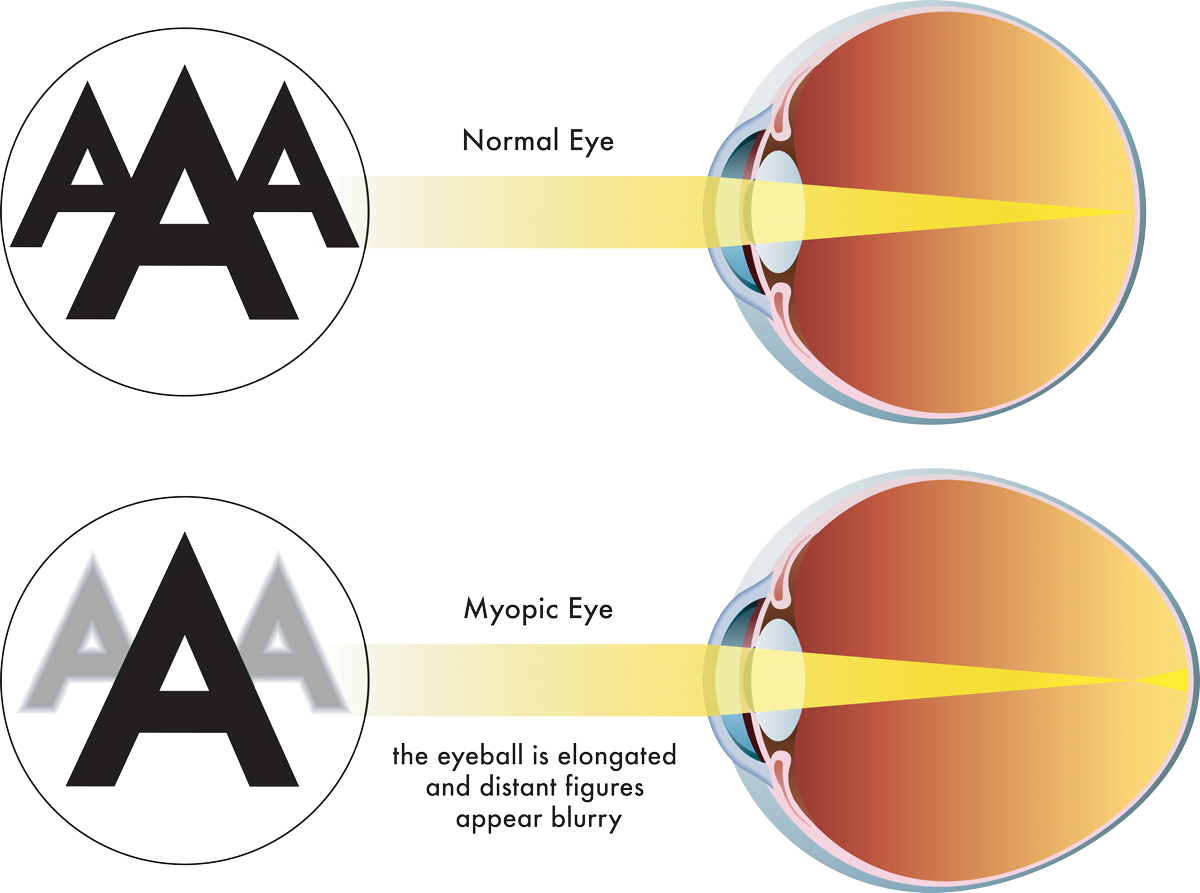


Nearsightedness, medically known as myopia, is a common vision condition where you can see nearby objects clearly, but distant objects appear blurry. This occurs because the eyeball is slightly too long, or the cornea is too curved, causing light rays to focus in front of the retina instead of directly on it. It typically develops in childhood and can stabilize in early adulthood, though it may progress. Symptoms include squinting, eye strain, and headaches. Correction is achieved with prescription eyeglasses, contact lenses, or refractive surgery like LASIK, which reshape the cornea to properly focus light onto the retina for clear distance vision.
Nearsightedness, or myopia, is a common refractive error where distant objects appear blurry while close-up vision remains clear. This occurs because the eye's shape causes light to focus in front of the retina instead of directly on it. Common symptoms include squinting, eye strain, headaches, and difficulty seeing things like road signs or classroom boards. It is typically diagnosed through a comprehensive eye exam. Correction options are eyeglasses, contact lenses, or for a more permanent solution, vision correction procedures like LASIK or PRK. Myopia often develops in childhood and can progress, so regular eye check-ups are crucial to update prescriptions and monitor eye health.
Nearsightedness, or myopia, is corrected by refocusing light directly onto the retina. The most common non-surgical fix is prescription eyeglasses or contact lenses, which use concave lenses to diverge light before it enters the eye. For a permanent solution, laser vision correction procedures like LASIK or PRK are highly effective. These surgeries use a laser to gently reshape the cornea, the eye's clear front surface, correcting its focusing power. Another excellent option for qualified candidates is the Implantable Collamer Lens (ICL), where a permanent, biocompatible lens is placed inside the eye. The best method depends on a comprehensive eye exam to assess your corneal thickness, prescription strength, and overall eye health.
Nearsightedness, or myopia, is primarily caused by a refractive error where the eyeball is slightly too long from front to back, or the cornea is too curved. This structural issue causes light entering the eye to focus in front of the retina instead of directly on it, resulting in blurred distance vision. While genetics play a significant role—with a strong likelihood of inheritance if one or both parents are myopic—environmental factors are also influential. Extensive "near work" such as prolonged reading or using digital devices, especially during childhood, is associated with its development and progression. The condition typically emerges in school-aged children and often stabilizes in early adulthood, though it can continue to change.
Nearsightedness, or myopia, is a common refractive error where distant objects appear blurry. While it cannot be permanently "cured" in the sense of being eliminated from the eye's structure, it can be effectively and permanently corrected to provide clear vision without daily reliance on glasses or contacts. The primary method for a lasting correction is laser vision correction, such as LASIK or PRK. These procedures reshape the cornea to properly focus light onto the retina. For individuals who are not candidates for laser surgery, an alternative like an implantable collamer lens (ICL) can provide a permanent solution. It is crucial to have a comprehensive consultation to determine the best treatment option based on your individual eye health and prescription.


130 reviews