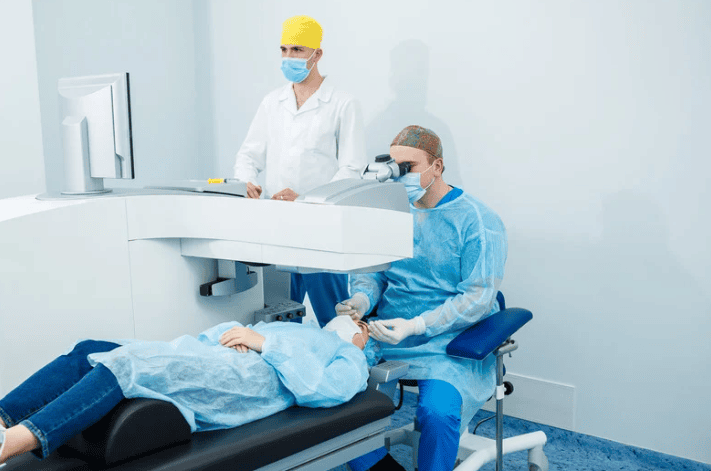
In 2026, both EVO ICL and LASIK are first-line vision correction procedures — neither is a backup option. EVO ICL now rivals LASIK even for mild to moderate myopia, offering superior night vision, zero dry eye risk, and complete reversibility. LASIK remains the faster, more affordable option with a 25+ year track record. The right choice depends on your corneal thickness, prescription level, dry eye history, and lifestyle. At Liberty Laser Eye Center, we provide both procedures and use advanced diagnostics to determine which will deliver your best possible outcome.
Table of Contents
Understanding the Two Procedures
What Is LASIK?
LASIK (Laser-Assisted In Situ Keratomileusis) has been the dominant refractive procedure since the late 1990s. A femtosecond laser creates a thin corneal flap, an excimer laser reshapes the underlying tissue to correct refractive errors, and the flap is repositioned — all in approximately 3 to 10 minutes per eye.
LASIK corrects:
-
Nearsightedness (myopia)
-
Farsightedness (hyperopia)
-
Astigmatism
In 2026, advanced platforms such as wavefront-guided, topography-guided (Contoura), and the newly FDA-approved Ray-Traced LASIK (Alcon WaveLight Plus) enable unprecedented customization. Patient satisfaction exceeds 95 percent, with over 90 percent achieving 20/20 or better uncorrected vision.
What Is EVO ICL?
EVO ICL (Implantable Collamer Lens) takes a fundamentally different approach. Instead of reshaping the cornea, a biocompatible lens made of Collamer — a collagen-copolymer material with a 30+ year stability record — is implanted behind the iris and in front of the natural crystalline lens through a micro-incision. No corneal tissue is removed.
The current US model features:
-
Central port design (AquaPORT) that allows natural aqueous humor flow, eliminating the need for pre-operative laser iridotomy
-
Built-in UV protection
-
Correction range up to -15 diopters of myopia and up to 4 diopters of astigmatism
-
The EVO+ optic (larger diameter for improved night vision) is standard in the US market up to -12 diopters
The FDA expanded the US age indication in February 2026 to cover patients aged 21 to 60 years, making EVO ICL available to nearly 8 million additional refractive patients.
Head-to-Head Comparison: EVO ICL vs LASIK (2026 Data)
| Factor | LASIK (2026 Technology) | EVO ICL | Clinical Advantage |
|---|---|---|---|
| Procedure Type | Corneal reshaping (tissue removed) | Lens implantation (no tissue removed) | EVO ICL for tissue preservation |
| Procedure Time | 3-10 minutes per eye | 5-7 minutes per eye (20-30 min total) | LASIK (slightly faster) |
| Visual Recovery | 20/20 or better by next morning; quality improves over 2-3 months | Functional vision within 24 hours; full clarity in 1-2 weeks; continues improving for 6-8 weeks | LASIK (faster initial) |
| Treatable Myopia Range | Mild to moderate (typically up to -8 to -10 D) | High myopia (up to -15 D, sometimes higher with combined approach) | EVO ICL (broader range) |
| Treatable Astigmatism | Yes | Up to 4 diopters | Comparable |
| Dry Eye Risk | Moderate (temporary; affects up to 30% initially) | None (corneal nerves preserved) | EVO ICL (significant advantage) |
| Night Vision Quality | Good; halos/glare may occur | Superior; less halos and starbursts per studies | EVO ICL (especially for large pupils/high myopia) |
| Reversibility | No (cornea permanently reshaped) | Yes (lens removable/exchangeable) | EVO ICL |
| UV Protection | No inherent UV protection | Built-in UV blocking in Collamer material | EVO ICL |
| Long-Term Corneal Health | Rare ectasia risk (0.04%-0.6%) | Excellent; no corneal weakening | EVO ICL |
| Cost per Eye (US Average 2026) | 2,000−3,500 | 4,000−6,000+ | LASIK (more affordable) |
| Patient Satisfaction | >95% | >95% | Comparable |
| Vision Improvement Rate | 88.3% in myopia cases | 93.3% in myopia cases | EVO ICL (statistically significant) |
| FDA Age Indication | 18+ | 21-60 (expanded February 2026) | Varies by age |
Data synthesized from:
Candidacy: Which Procedure Fits Your Eyes?
You May Be a Better LASIK Candidate If:
-
You have mild to moderate myopia (approximately -1 to -6 diopters) with adequate corneal thickness
-
You have no history of chronic dry eye
-
You want the fastest possible visual recovery
-
You prefer a lower upfront cost
-
You are between ages 18 and 40 with a stable prescription for at least 12 months
-
You do not participate in high-impact contact sports where corneal flap trauma is a concern
LASIK works exceptionally well for standard prescriptions with healthy corneas. The procedure has been performed over 40 million times worldwide and remains the most studied elective surgery in history.
You May Be a Better EVO ICL Candidate If:
-
You have moderate to high myopia (above -6 diopters) or thin corneas that rule out LASIK
-
You have chronic dry eye or are at high risk for post-LASIK dryness
-
You have large pupils and are concerned about night driving glare
-
You value reversibility — the lens can be removed or exchanged if your vision needs change
-
You want to preserve corneal tissue for potential future procedures
-
You are between ages 21 and 60
EVO ICL has become the preferred choice for patients previously told they were not LASIK candidates. At some high-volume centers, approximately 20 percent of LASIK candidates switch to EVO ICL after screening reveals advantages.
The Shift in 2026: EVO ICL for Mild Myopia
A significant development is the growing use of EVO ICL for patients with low to moderate myopia who are also LASIK candidates. At the ASCRS 2025 meeting, data showed that EVO ICL is no longer framed as a backup to LASIK — both procedures are presented as equally strong first-line choices, allowing patients to weigh their individual benefits.
With over 3 million lenses implanted globally, and STAAR Surgical surpassing 4 million ICLs sold as of early 2026, real-world evidence continues to reinforce the safety and effectiveness of the EVO ICL platform.
Recovery and Visual Outcomes: What to Expect
LASIK Recovery Timeline
-
Day 1 post-op: Most patients achieve 20/20 or better uncorrected vision. Some fogginess persists, especially around lights at night.
-
Week 1: Visual quality continues improving. Most patients return to work, driving, and exercise within 24 to 48 hours.
-
1 to 3 months: Contrast sensitivity and night vision quality progressively refine.
-
Long-term: Stable vision for decades. Age-related presbyopia (needing reading glasses after age 40) still occurs regardless of LASIK.
Post-operative care: Preservative-free lubricating drops, antibiotic and steroid drops as prescribed, protective eye shields during sleep for the first week. Avoid rubbing eyes indefinitely — chronic eye rubbing can induce corneal ectasia.
EVO ICL Recovery Timeline
-
Day 1 post-op: Many patients see 20/20 or better. Functional vision sufficient for driving and working is typically present. Vision may be foggy around lights at night.
-
Week 1: Vision sharpens significantly. Most daily activities resume within 24 hours.
-
1 to 2 weeks: Full clarity achieved for most patients.
-
6 to 8 weeks: Final visual quality stabilizes, including optimal night vision performance.
-
Long-term: The EVO ICL lens is designed to remain in place permanently. It does not degrade. The 3-year FDA multicenter study confirmed accuracy and stability of refractive correction with high levels of uncorrected distance visual acuity.
Post-operative care: Prescribed antibiotic and anti-inflammatory drops, protective shields at night, no eye rubbing. Follow-up visits typically include 1-day, 1-week, 1-month, and annual exams thereafter.
Key Recovery Differences
-
LASIK recovery is measurably faster in the first 24 to 48 hours.
-
EVO ICL requires a slightly longer drop regimen but avoids the temporary dry eye spike common after LASIK.
-
Both procedures allow most patients to drive and work the next day.
-
Night vision improvement takes 6 to 8 weeks for EVO ICL; 2 to 3 months for LASIK.
In the FDA multicenter study, 99.5 percent of EVO ICL treated eyes reached 20/40 vision or better, and approximately 85.8 percent achieved 20/20 or better at three years.
Risks and Side Effects: An Evidence-Based Comparison
Both procedures have excellent safety profiles when performed on properly selected candidates by experienced surgeons. However, the risk profiles differ meaningfully.
LASIK-Specific Risks
-
Dry Eye: Up to 30 percent of patients experience temporary dry eye symptoms in the initial weeks to months. This occurs because corneal nerves are severed during flap creation and require time to regenerate. Most cases resolve within 6 to 12 months.
-
Night Vision Disturbances: Glare, halos, and starbursts can occur, particularly in patients with large pupils or high prescriptions. These typically diminish over 3 to 6 months.
-
Corneal Ectasia: A rare but serious complication where the cornea progressively thins and bulges. Incidence is reported between 0.04 percent and 0.6 percent. Modern screening protocols have reduced this risk substantially.
-
Flap Complications: Extremely rare with modern femtosecond lasers (less than 0.1 percent).
-
Enhancement Need: Some patients require a touch-up procedure over 10 to 20 years.
EVO ICL-Specific Risks
-
Intraocular Pressure Elevation: The central port design has nearly eliminated the risk of pupillary block that required pre-operative iridotomy in older ICL models. The 3-year FDA study confirmed effective physiologic aqueous flow.
-
Endothelial Cell Loss: Mean endothelial cell density decreased by 3.0 percent at 1 year and 6.7 percent at 3 years in the FDA trial — within safe limits and comparable to natural age-related loss.
-
Lens Exchange: Occasional need for lens size exchange (approximately 1 in 400 cases). Rare dissatisfaction leading to lens removal (2 out of over 2,000 cases in one high-volume practice).
-
Cataract Formation: Extremely rare with proper vault and sizing. The anterior subcapsular cataract rate in the FDA study was 0.16 percent.
-
Glare and Halos: May occur initially, comparable to or less persistent than LASIK. Long-term studies show glare decreases over time and is related to pupil dilation velocity.
The Dry Eye Distinction
The most clinically significant difference between the two procedures is dry eye risk. EVO ICL requires only a small corneal incision that does not transect corneal nerves, while LASIK severs a significant number of nerves during flap creation. For patients with pre-existing dry eye, contact lens intolerance, or occupations involving prolonged screen use, EVO ICL offers a clear advantage.
Cost Comparison: Investment and Value
| Cost Factor | LASIK | EVO ICL |
|---|---|---|
| Average Cost per Eye (US, 2026) | 2,000−3,500 | 4,000−6,000+ |
| Average Cost Both Eyes | 4,000−7,000 | 8,000−12,000+ |
| What Drives the Cost | Laser technology, surgeon fee, facility fee | Custom-manufactured Collamer lens (made in Switzerland), surgical facility fee, surgeon fee |
| Insurance Coverage | Typically elective; not covered | Typically elective; not covered |
| FSA/HSA Eligible | Yes | Yes |
| Financing Options | Widely available (CareCredit, Alphaeon, in-house plans) | Widely available |
| Long-Term Value Consideration | May require enhancement over 10-20 years | Lens lasts indefinitely; removable if needed |
Pricing data:
EVO ICL costs 30 to 50 percent more than LASIK primarily because each lens is custom-manufactured using advanced Collamer material. However, when amortized over decades of glasses and contact lens expenses, both procedures often prove more economical than ongoing corrective lens costs, which average over $13,000 per decade.
At Liberty Laser Eye Center, we offer transparent pricing with no hidden fees, accept FSA and HSA payments, and provide financing options to make both procedures accessible for patients throughout Washington DC, Maryland, and Northern Virginia.
2026 Trends: The Shifting Landscape of Vision Correction
Market Data
-
The global implantable collamer lens market is projected to grow from 20.77 billion US dollars in 2025 to 22.2 billion US dollars in 2026, a CAGR of 6.9 percent.
-
Laser-based refractive procedures that require corneal tissue removal have declined nearly 40 percent over the past three years, according to STAAR Surgical data.
-
EVO ICL sales continue surging as patients seek options that avoid corneal tissue removal.
-
The FDA expanded EVO ICL age indication to 21-60 years in February 2026, reflecting confidence in long-term safety data.
Technology Advances
-
Robotic femtosecond LASIK: A prospective study presented at ASCRS 2026 demonstrated the first use of a robotic laser system for LASIK flap creation, showing promising safety signals.
-
Ray-Traced LASIK: FDA-approved as Alcon WaveLight Plus, this technology represents a paradigm shift in customized corneal ablation.
-
EVO ICL long-term data: The 3-year FDA multicenter study and multiple 5-year follow-up studies continue to demonstrate excellent safety, stability, and patient satisfaction.
Why Choose Liberty Laser Eye Center for Your Procedure
At Liberty Laser Eye Center, we offer expert LASIK eye surgery and vision correction treatments serving Washington DC, Maryland, Alexandria, Arlington, Tyson’s Corner, and all of Northern Virginia. Our approach ensures personalized care with advanced technology:
-
Comprehensive Diagnostic Evaluation: We perform detailed corneal mapping, wavefront analysis, anterior chamber depth measurement, and endothelial cell assessment — the full diagnostic workup needed to determine whether LASIK or EVO ICL is safer and more effective for your specific eyes.
-
Dual Procedure Expertise: Unlike centers that only offer LASIK, we are experienced in both procedures, meaning our recommendation is based on your best outcome, not our limitations.
-
Advanced Technology Platform: From topography-guided LASIK to EVO ICL with the latest EVO+ optic, we utilize the same technologies discussed in the peer-reviewed literature.
-
Transparent, Competitive Pricing: Clear cost breakdowns, FSA/HSA acceptance, and financing assistance.
-
Direct Surgeon Access: Post-operative care includes direct communication with your surgeon, not a triage service.
-
Proven Track Record: Thousands of successful procedures performed for patients across the DC metro area.
Frequently Asked Questions
1. How do I know which procedure is right for me?
A comprehensive pre-operative evaluation — including corneal topography, pachymetry (corneal thickness measurement), pupil size assessment, and anterior chamber depth analysis — determines candidacy. At Liberty Laser Eye Center, this evaluation is thorough and personalized.
2. Is EVO ICL worth the higher cost?
If you are not a LASIK candidate due to thin corneas or high prescription, EVO ICL is often the only viable option and is absolutely worthwhile. Even if you are a LASIK candidate, the dry eye advantage, reversibility, and superior night vision may justify the investment. Over decades, both procedures are more economical than contact lenses and solutions.
3. Does either procedure hurt?
No. Both procedures use topical anesthetic (numbing) drops. Patients typically feel pressure but no pain during surgery. Post-operative discomfort is mild and manageable with prescribed and over-the-counter medications.
4. What happens if my vision changes years later?
LASIK results are permanent but do not prevent age-related changes like presbyopia (needing reading glasses after 40) or cataracts. EVO ICL lenses can be removed or exchanged if significant prescription changes occur. Cataract surgery can be performed safely after either procedure.
5. Can I have EVO ICL if I was previously told no to LASIK?
In many cases, yes. EVO ICL was specifically designed for patients with thin corneas, high prescriptions, or dry eye — precisely the profiles that often disqualify patients from LASIK. A patient at -12.00 diopters, for example, would typically exceed safe corneal tissue removal limits for LASIK but is well within EVO ICL treatment range.
6. How long do the results last?
Both procedures provide long-term correction. LASIK corneal reshaping is permanent. EVO ICL lenses are designed to remain in place indefinitely, with studies showing 98 percent stability at 10 years.
Making Your Decision
Both EVO ICL and LASIK are outstanding vision correction options in 2026. The procedures differ in mechanism, recovery, cost, and ideal candidacy — but both deliver life-changing visual freedom with satisfaction rates exceeding 95 percent.
The decision ultimately comes down to your specific eye anatomy, prescription, lifestyle, and priorities. The most critical step is a comprehensive evaluation with an experienced refractive surgeon who offers both procedures and can provide an unbiased recommendation.
At Liberty Laser Eye Center, serving Washington DC, Maryland, Alexandria, Arlington, Tyson’s Corner, and all of Northern Virginia, we combine advanced diagnostic technology with decades of surgical experience to help each patient achieve their best possible vision. Whether LASIK or EVO ICL is your optimal path, we are here to guide you through every step.
Schedule your consultation today and take the first step toward clear, glasses-free vision.
*Sources: Optometry Times ASCRS 2025 Coverage ; FDA Multicenter EVO ICL 3-Year Study ; SHARPEVISION 2026 Comparison Data ; Berkeley Eye Center Procedure Comparison ; STAAR Surgical Market Data ; Refractive Surgery Council Industry Data; AAO 2025 Sessions; ASCRS 2026 Technology Presentations.*