
We’ve all been there. You pick up your glasses from the optician, slide them on, and the world snaps into focus. Then you glance at the little paper prescription they handed you, and it looks like a secret code. There’s the big obvious numbers like SPH and CYL, but tucked in there is this little column labeled “VA” and you have no idea what it means. Maybe you assume it’s some technical measurement you don’t need to worry about. Or maybe you’re the type who obsesses over every detail, trying to figure out if your vision is “normal” or not. Either way, understanding what VA actually tells you can save you a lot of confusion—and maybe even a few headaches.
Key Takeaways:
- VA stands for Visual Acuity, which measures how clearly you see at a standard distance, usually expressed as a fraction (e.g., 20/20).
- It is not the same as your prescription (SPH, CYL, AXIS). The prescription tells the lab how to make the lens; VA tells you how well you see with that lens.
- A VA of 20/40 or worse may affect your ability to drive without corrective lenses in most states.
- Your VA can change over time due to age, eye health, or even fatigue, so it’s worth paying attention to.
Key Takeaways:
- VA stands for Visual Acuity, which measures how clearly you see at a standard distance, usually expressed as a fraction (e.g., 20/20).
- It is not the same as your prescription (SPH, CYL, AXIS). The prescription tells the lab how to make the lens; VA tells you how well you see with that lens.
- A VA of 20/40 or worse may affect your ability to drive without corrective lenses in most states.
- Your VA can change over time due to age, eye health, or even fatigue, so it’s worth paying attention to.
Table of Contents
What VA Actually Measures
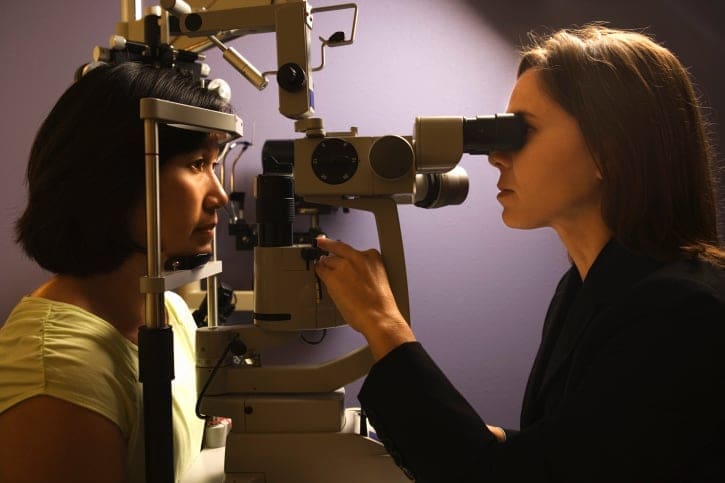
Visual Acuity (VA) is the standard way eye doctors quantify how sharp your vision is. When you sit in that chair and read letters off a chart, that’s a VA test. The result is written as a fraction: 20/20, 20/40, 20/200, etc. The top number is the distance in feet between you and the chart (usually 20 feet). The bottom number is the distance at which a person with “normal” vision could read the same line of letters. So 20/40 means you can read at 20 feet what a normal eye can read at 40 feet. It’s a measure of clarity, not a prescription.
Here’s where people get tripped up: VA is not the same thing as your refractive error. Your prescription (the SPH, CYL, AXIS numbers) tells the lab how to grind the lens to correct your vision. VA tells the doctor (and you) how well your eyes perform after correction. I’ve had patients come in convinced their prescription was wrong because they saw 20/30 on the chart, but their prescription was actually fine—their eyes just had a different baseline. It’s a subtle but important distinction.
Why VA Matters More Than You Think
Most of us treat VA as just a number, but it has real-world consequences. For example, in most states, you need a VA of at least 20/40 in one eye to drive without corrective lenses. If you’re below that, you’re legally required to wear glasses or contacts while driving. I’ve seen people fail their driver’s license vision test because they didn’t realize their VA had slipped. It’s not a huge deal if you have glasses, but it’s a rude awakening if you don’t.
Beyond driving, VA influences everything from reading street signs to recognizing faces across a room. A VA of 20/20 is often considered “perfect,” but it’s really just average. Many people have 20/15 or even 20/10 vision, meaning they see better than the norm. On the flip side, 20/200 is the threshold for legal blindness in the U.S. (with best correction). That’s a big range, and where you fall on that spectrum can affect your daily life more than you might expect.
How VA Relates to Your Prescription
Here’s a common misunderstanding I see: someone looks at their prescription and sees a high SPH number, then assumes their VA must be terrible. That’s not how it works. A person with -5.00 diopters of myopia can still achieve 20/20 vision with the right lenses. The prescription and VA are related but not directly proportional. Think of it this way: your prescription is the tool, and VA is the result. A strong prescription doesn’t automatically mean bad VA, and a weak prescription doesn’t guarantee perfect VA.
The Hidden Factors That Skew Your VA
Your VA on a given day isn’t set in stone. It fluctuates based on things you might not consider. Dry eyes, for example, can blur your vision temporarily. I’ve had patients come in for a routine exam, and their VA was worse than expected simply because they’d been staring at a computer screen all morning. A few drops of artificial tears later, and they were reading 20/20 again. Fatigue, allergies, even the time of day can affect your VA. That’s why doctors typically measure VA multiple times during an exam and average the results.
Another factor is contrast sensitivity. Two people can both have 20/20 VA, but one might struggle to see in low light or against a gray background. Standard VA tests use high-contrast black letters on a white background, which doesn’t reflect real-world conditions perfectly. So if you feel like your vision is worse at night or in dim restaurants, your VA number might not tell the whole story.
When VA Misleads You
VA is a useful metric, but it’s not the whole picture. I’ve seen patients with 20/20 VA who still complain of eye strain, headaches, or difficulty focusing. That’s because VA measures static clarity—how well you see a stationary object at a fixed distance. It doesn’t measure depth perception, peripheral vision, or how well your eyes work together as a team. Those are separate tests. So if your VA looks good but your eyes feel tired, don’t ignore it. There might be an underlying issue like binocular vision dysfunction or an accommodative problem.
There’s also the phenomenon of “20/20 with effort.” Some people can force their eyes to read the 20/20 line, but it takes concentration and squinting. That’s not true 20/20. A good doctor will note if you’re straining to achieve that result. If you’re constantly pushing to see clearly, you’re not actually seeing clearly—you’re compensating. That’s a sign you might need an updated prescription or vision therapy.
What the Numbers Actually Mean (A Practical Guide)
Let’s translate the VA fraction into real life. Here’s a rough guide based on what we see in practice:
| VA Fraction | What It Looks Like in Daily Life |
|---|---|
| 20/20 | Standard clarity. Can read most road signs, recognize faces at a distance, and read fine print without effort. |
| 20/30 | Slightly blurred at distance. May miss a line on the eye chart. Can still drive without correction in most states, but street signs might be fuzzy. |
| 20/40 | Legally requires glasses for driving in many states. TV subtitles may be hard to read from the couch. |
| 20/60 | Significant blur. Can’t recognize faces across a room. Reading menus or signs is difficult without correction. |
| 20/100 | Severe blur. Legal blindness threshold in some contexts. Can only see the big “E” on the chart. |
| 20/200 | Legal blindness (with best correction). Can’t read standard print without strong magnification. |
This table is a generalization, but it gives you a sense of where you stand. If your VA is 20/40 or worse, it’s worth asking your doctor if you’re a candidate for LASIK or other correction options. At Liberty Laser Eye Center located in Vienna, VA, we often see patients who assumed their 20/40 vision was “fine” until they realized how much clearer life could be after LASIK surgery. It’s not just about passing a test—it’s about quality of life.
Common Mistakes People Make With Their VA
One of the biggest mistakes I see is people assuming their VA is permanent. It’s not. Your eyes change over time, especially after age 40 when presbyopia sets in. That’s why annual exams matter. I’ve had patients who hadn’t updated their glasses in five years, wondering why they were getting headaches. Their VA had slipped from 20/20 to 20/30, but they didn’t notice because the change was gradual.
Another mistake is ignoring the “VA with correction” number. Some people focus only on their uncorrected VA (what they see without glasses) and assume that’s their baseline. But the corrected VA (what you see with glasses or contacts) is what matters for most daily activities. If your corrected VA is 20/20, you’re in good shape. If it’s 20/40 even with glasses, there might be an underlying eye health issue like cataracts or macular degeneration.
When VA Doesn’t Tell the Full Story
There are cases where VA is almost irrelevant. For instance, someone with keratoconus (a condition where the cornea thins and bulges) might have poor VA but still see reasonably well with specialty contact lenses. Their VA number looks bad on paper, but their functional vision is better than the number suggests. Conversely, someone with early glaucoma might have 20/20 VA but significant peripheral vision loss. VA tests don’t catch that.
This is why we never rely on VA alone when evaluating a patient for LASIK or other refractive surgery. At Liberty Laser Eye Center located in Vienna, VA, we run a battery of tests—corneal topography, wavefront analysis, pupil size, tear film assessment—before recommending LASIK eye surgery. VA is just one data point. If a patient comes in with 20/20 VA but unstable vision or dry eyes, LASIK might not be the best choice. The number doesn’t always tell you what to do.
Alternatives to Relying on VA Alone
If you’re trying to assess your own vision, don’t just look at the VA number. Pay attention to symptoms: Do you have trouble reading at night? Do you get headaches after screen time? Are you squinting more than usual? Those are better indicators than a single fraction. Also, consider getting a contrast sensitivity test or a visual field test if you’re worried about something specific.
For those considering LASIK surgery, VA is a starting point but not a deciding factor. The best candidates are people with stable prescriptions (no big changes in the last year), healthy corneas, and realistic expectations. If your VA is 20/20 with glasses but you hate wearing them, you’re a candidate. If your VA is 20/200 without glasses and you’re tired of thick lenses, you’re also a candidate. The key is the overall health of your eyes, not just the number on the chart.
Final Thoughts on VA
VA is a useful tool, but it’s just one tool. Don’t let a single number define your vision or your confidence. If your VA is 20/30, you’re not “broken.” You might just need a tweak to your glasses. If it’s 20/200, that doesn’t mean you can’t live a full life—it means you need the right correction. And if you’re curious about whether LASIK could improve your VA, the only way to know is to get a thorough exam. There’s no substitute for a professional evaluation.
At the end of the day, vision is about how you experience the world, not a fraction on a piece of paper. So the next time you look at your prescription and see that VA column, you’ll know what it means—and more importantly, you’ll know what it doesn’t mean. If something feels off, trust your instincts. Your eyes are worth the attention.
Related Articles
Understanding a -1.50 Eye Prescription: What It Means for Your Vision
Finding The Best Optometrist For Your Family In Washington DC
Prescription Stability Requirements For Laser Surgery
The Ultimate Washington D.C. Annual Eye Exam Prep Guide: What To Bring, What To Ask, And How To Read Your Results
Plano Eye Prescription: Sphere Meaning, LASIK & Vision Correction
People Also Ask
To understand your glasses prescription, the term VA stands for Visual Acuity, which is a measurement of your sharpness of vision, often recorded as 20/20. The prescription itself includes numbers for sphere (SPH) to correct nearsightedness or farsightedness, cylinder (CYL) for astigmatism, and axis for its orientation. The VA number is typically found in the far right column and is not a part of the corrective lens power. If you are considering a more permanent solution to reduce your dependence on glasses, you may find the article LASIK Eye Surgery Tysons Corner, VA | Liberty Laser Eye Center helpful. At Liberty Laser Eye Center, we recommend a comprehensive evaluation to see if you are a suitable candidate for vision correction.
The term "20/20" refers to standard visual acuity, meaning you can see at 20 feet what a person with normal vision sees at 20 feet. In Vienna and Fairfax County, Virginia, achieving 20/20 distance vision is a common goal for many patients. However, it is important to understand that 20/20 does not guarantee perfect vision, as it does not measure contrast sensitivity, depth perception, or night vision. At Liberty Laser Eye Center, we evaluate each patient's overall visual health. For those concerned about conditions like keratoconus, we recommend reviewing our internal article titled LASIK With Keratoconus Risk Factors to understand potential risk factors before pursuing any vision correction procedure.
The "VA" on a glasses prescription stands for Visual Acuity. This measurement indicates how clearly you see at a specific distance, typically 20 feet. It is often written as a fraction, such as 20/20, which represents normal vision. The top number is the distance in feet from the eye chart, and the bottom number is the line you read correctly. For example, 20/40 means you see at 20 feet what a person with normal vision sees at 40 feet. This number is not part of your lens power; it simply records your vision quality during the exam. At Liberty Laser Eye Center, we use this baseline to assess your current eyesight. For more details on how vision correction can improve your prescription, our internal article titled Add-On Eye Prescription: Enhance LASIK & Vision Correction | Liberty Laser Eye Center Vienna, VA provides comprehensive insights into enhancing your visual outcomes.