

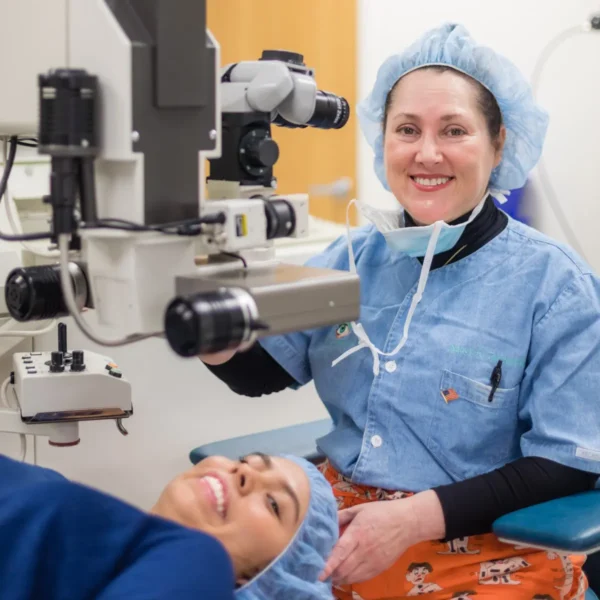

I had a great experience at Liberty Laser Eye Center. Dr. Nancy Tanchel and her entire team were extremely professional, kind, and made me feel comfortable throughout the whole process. They explained everything clearly and answered all of my questions, which really helped me feel confident before the procedure.
The surgery went smoothly and the staff was very supportive from start to finish. I’m very grateful to Dr. Tanchel and her team for their excellent care and professionalism.
Thank you all for helping me improve my vision. I truly appreciate the great work you do.

My vision wasn't terrible, but I was just sick of dealing with the hassle of contacts for sports until I came here. Great and professional business

I had a really good experience at Liberty Laser Eye Center. The staff was friendly and made me feel comfortable the whole time. The procedure was quick, and my vision is so much better now.

Informative staff offering careful evaluations and supportive patient care throughout the process.

Having LASIK surgery was the best thing I have ever done. Waking up every morning with the ability to see 20/20 without having to reach for my glasses or contacts is the ultimate freedom. The surgery was painless and the staff was incredible. I highly recommend it so don't wait!

Brought My grandmother for her eye exam. Jeeimy helped us and explained in detail such amazing team.

I’d been thinking about LASIK for years but kept putting it off out of sheer nervousness. The staff at Liberty are some of the kindest and most patient people I’ve ever met. It’s been a few months and I’m still not used to the freedom of just rolling out of bed and seeing.

I consider this the best investment I've ever made in myself, no question about it. The freedom of just rolling out of bed and being able to see is something I'll never take for granted.
All-Laser LASIK, also known as bladeless or femtosecond LASIK, is generally considered a more advanced and precise technique compared to traditional microkeratome LASIK. In this procedure, the corneal flap is created using a femtosecond laser instead of a mechanical blade. This allows for a more customized and predictable flap with potentially greater accuracy in thickness and shape. Many surgeons and patients prefer this method due to its enhanced safety profile, reduced risk of certain flap-related complications, and suitability for a wider range of corneal shapes. While it may be associated with a slightly higher cost, the consensus in refractive surgery is that all-laser technology offers superior precision and control, leading to excellent visual outcomes and high patient satisfaction.
All-Laser LASIK is a modern, bladeless vision correction procedure. It uses two precise lasers: a femtosecond laser to create a thin corneal flap and an excimer laser to reshape the underlying corneal tissue and correct refractive errors like nearsightedness, farsightedness, and astigmatism. By eliminating the use of a mechanical blade (microkeratome), the all-laser technique enhances safety, precision, and comfort for the patient. It typically results in a faster visual recovery and may reduce the risk of certain flap-related complications. For a detailed overview of this advanced technology and its benefits, we invite you to read our internal article, All-Laser LASIK Services in Bethesda, MD.
Yes, you can absolutely get laser eye surgery if you have astigmatism. Modern laser vision correction procedures, such as LASIK and PRK, are specifically designed to treat astigmatism by reshaping the irregularly curved cornea into a more spherical shape. This is achieved using advanced wavefront-guided technology that maps the unique imperfections of your eye for a highly personalized treatment. The suitability for surgery depends on the degree of your astigmatism, corneal thickness, and overall eye health, which are determined during a comprehensive evaluation. For a detailed comparison of how different procedures address astigmatism, we recommend reading our internal article LASIK Vs. PRK: Which Is Right For You?.
Type 2 diabetics can often be candidates for laser eye surgery, but their eligibility depends on strict criteria related to their overall eye and systemic health. The primary concern is that diabetes can cause diabetic retinopathy, where blood vessels in the retina are damaged, and can lead to other vision issues like macular edema. For surgery to be considered, the diabetes must be well-controlled with stable blood sugar levels over an extended period, and a comprehensive pre-operative eye exam must confirm there is no active retinal disease. Even with good control, the healing process may be slower, and the risk of post-operative complications like infection or fluctuating vision is higher. A thorough evaluation by an ophthalmologist is essential to assess individual risk and determine if the potential benefits outweigh the risks for each patient.
The cost of all-laser LASIK, also known as bladeless or femtosecond LASIK, varies significantly based on geographic location, the surgeon's expertise, and the technology used. On average in the United States, the price typically ranges from $2,000 to $3,000 per eye. This investment generally includes the pre-operative consultation, the surgical procedure itself, and post-operative care for a standard period. It is crucial to understand that the quoted price should be for all-laser technology, where a femtosecond laser creates the corneal flap instead of a mechanical microkeratome blade. While cost is an important factor, choosing a surgeon based on experience, technology, and a thorough patient evaluation is essential for a safe and effective outcome. Many centers offer financing plans to make the procedure more accessible.
Certain individuals are not ideal candidates for laser eye surgery. Those under 18, as their vision is still changing, should typically wait. People with unstable vision prescriptions that have changed in the last year are also advised to postpone surgery. Individuals with certain medical conditions, such as autoimmune diseases (e.g., rheumatoid arthritis), uncontrolled diabetes, or conditions that impair healing, are often not suitable candidates. Additionally, those with thin or irregular corneas, severe dry eye syndrome, or active eye diseases like keratoconus or glaucoma may be excluded. Pregnant or nursing women should delay surgery due to hormonal fluctuations affecting vision. A comprehensive pre-operative evaluation at a clinic like Liberty Laser Eye Center is essential to determine candidacy based on these and other individual health factors.


130 reviews

